The warming spring weather means it is time to fertilize your cool-season lawn. What kind of fertilizer should you apply? How much? And how to apply?
What’s In a Bag of Fertilizer?
All lawn fertilizers contain three “Macronutrients” – nitrogen (N), phosphorus (P), and magnesium (K). Nitrogen causes the grass blades to grow tall. Phosphorus drives root growth. And Magnesium helps the grass plant deal with stress.
Most fertilizer bags prominently display their “N-P-K” rating (for example, 24-0-6). The first number is the percentage nitrogen in the bags contents. The second number is the percentage of phosphorus, and the third number is the percentage of magnesium. This means that your 45 lb bag of 24-0-6 contains:
- Nitrogen: ((\pu{ 45 lbs }\times\pu{ 24 \% } = \pu{ 10.8 lbs } ))
- Phosphorus: ((\pu{ 45 lbs }\times\pu{ 0 \% } = \pu{ 0.0 lbs } ))
- Magnesium: ((\pu{ 45 lbs }\times\pu{ 6 \% } = \pu{ 2.7 lbs } ))
The remainder of the bag may contain various micronutrients, such as iron (which helps the grass become greener), sulphur, manganese and zinc. It also contains “filler”, which does not feed the grass but does make the fertilizer easier to spread (it is difficult to apply small quantities of fertilizer with consumer-grade spreaders).
Note that there are two general types of nitrogen – fast-release and slow release. The fast-release nitrogen will cause a quick, visible response within a few days of application. The slow-release nitrogen will feed the grass over a span of several weeks.
How Much Fertilizer Should I Apply?
Cool season lawns need nitrogen in spring to “wake up” from their winter slumber (dormancy). The rule of thumb is to apply 0.75 lbs of nitrogen per 1000 square feet of grass.
If you apply too much nitrogen, you can burn your grass. For instance, if you accidentally spill a high-nitrogen fertilizer in your grass, you could get “fertilizer burn” in that area. If this happens, try to clean up as much of the spilled material as possible, then thoroughly water that area.
Applying too much fertilizer can harm the environment. For instance, phosphorus can wash into local waterways where it causes algae to grow, harming fish. Some areas ban phosphorus in lawn fertilizer to prevent this problem.
Calculating Application Rate
Now let’s do some math!
I heard that groan. If you want to skip the math, click here. But I really recommend that you empower yourself by learning how to calculate fertilizer application rates.
My front yard measures 2500 square feet1. My backyard is 5500 square feet. I want to apply 0.75 lbs of nitrogen per 1000 square feet. How much fertilizer should I apply to the front and back yards assuming I use a 45 lb bag of 24-0-6 fertilizer?
First, let’s define the following units:
- lbsN: pounds of nitrogen
- lbsFert: the total pounds of fertilizer that I need to apply
Let’s define the facts that we know. Include the units along with the value to ensure that we use consistent units throughout the calculation.
| Fact | Mathematical Expression of Fact with Units |
|---|---|
| I want to apply 0.75 pounds of nitrogen per 1000 square feet | ((\frac{\pu{ 0.75 lbsN }} {\pu{ 1000 sqft} })) |
| I need to cover my front yard, which is 2500 square feet | ((\pu{2500 sqft})) |
| Our bag of fertilizer contains 24% nitrogen. In other words, the ratio of nitrogen to the total amount of fertilizer is 24% or 0.24 | ((\pu{ 0.24 lbsN // lbsFert })) |
Given the three facts above, how much 24-0-6 fertilizer do I need to apply to my front yard in order to cover the yard at the rate of 0.75 pounds of N per thousand square feet? Expressing this question in terms of the units I have defined above, what are the “lbsFert” that I need to apply to my front yard?
Let’s create an equation that converts the facts above into “lbsFert”:
$$\frac{ \frac{\pu{ 0.75 lbsN }} {\pu{ 1000 sqft} }\times \pu{2500 sqft}}{ \pu{ 0.24 lbsN // lbsFert }}$$
Next, we simplify the units by cancelling those found in both the numerator and the denominator (sqft and lbsN), which gives us:
$$\frac{\frac{0.75}{1000}\times2500}{0.24} \ \pu{ lbsFert }$$
Which gives us the answer:
$$7.8125 \ \pu{ lbsFert }$$
So I need to apply 7.8125 pounds of 24-0-6 fertilizer to my 2500 sq ft front yard in order to cover it with 0.75 pounds of nitrogen per thousand square feet.
Let’s check our calculation:
- I will apply 7.8125 pounds of 24-0-6 fertilizer: $$\pu{ 7.8125 lbsFert }$$
- How much nitrogen will I apply using the 24-0-6 fertilizer?
$$\pu{ 7.8125 lbsFert }\times \pu{ 0.24 \frac{ lbsN }{ lbsFert }} = \pu{ 1.875 lbsN}$$ - Since my front yard is 2500 square feet, how much nitrogen will I apply per 1000 square feet?
$$\frac{ \pu{1.875 lbsN} } { \pu{ 2500 sqft } } \times \frac{ \pu{ 1000 sqft } } { 1000sqft } = \pu{ 0.75 \frac{ lbsN }{ 1000sqft }}$$
QED – our calculation is correct!
Now that we understand how the math works, let’s write a general formula:
$$\pu{ lbs of Fertilizer to apply } = \frac { \pu{( Desired lbs of N per 1000 sq ft )} \times \pu{(lawn size in square feet / 1000 )} } { \pu{( \% of N in our fertilizer )} }$$
So how much 24-0-6 should I apply to my 5500 sq ft backyard to achieve a rate of 0.75 pounds of nitrogen per 1000 square feet?
( 0.75 * 5500/1000 ) / 0.24 = 17.1875 lbsFert
How to Measure Fertilizer
The 24-0-6 fertilizer that I use comes in a 45 pound bag. And we learned above that I need to apply 7.185 pounds to the front yard and 17.1875 pounds to the back yard. So how do I do this?
Method 1
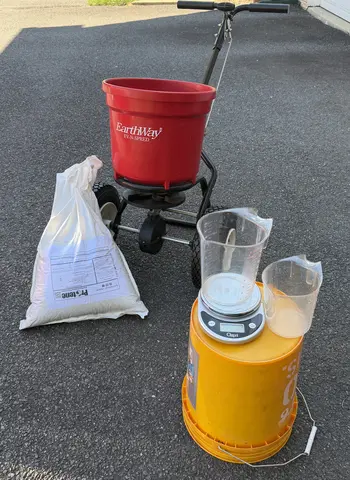
I bought a cheap five gallon bucket from Home Depot (buckets from Lowes, Costco or other stores work equally well). I also bought a small, handheld luggage scale from Amazon. I pour fertilzer into the bucket until the luggage scale indicates I have the correct amount. NOTE: Don’t forget to subtract the weight of the bucket! (Or use the “tare” function on the luggage scale).
Method 2
I hate having half empty bags of fertilizer laying around my garage. Since 7.8125 plus 17.1875 lbs equals 25 lbs, and my bag is 45 lbs, I first divide the bag in half. Then, I divide the half into three thirds. I apply 1/3rd to the front yard and 2/3rd to the backyard.
“Really?? After doing all that math, you throw it away and just eyeball it?” Yes and no. I really need a 50 lb bag to properly apply, but I only have a 45 lb bag. So I slightly underapply. My point is that this doesn’t need to be perfect or exact. If I apply 0.6 lbsN per 1000 square feet, the grass will be perfectly happy. I’ll just need to apply the next round of fertilizer a bit earlier. No big deal.
What is important is to not overapply the fertilizer. If you do, your grass with either:
- Grow like crazy and you’ll need to cut it every three days, or
- Die
Which of these two happens depends on how much you overapply.
How to Evenly Spread Fertilizer
The math above might seem difficult, but the real challenge is applying the fertilizer evenly.
Spreader Calibration
Your spreader most likely has a dial that controls the rate at which it applies fertilizer. But often the spreader manual doesn’t give you a nice chart that lists how many pounds per 1000 sqft are applied for each settings. And to be fair, the manufacturer can’t really give you this info, because the rate depends on how fast you walk. And the quality control for big box store spreaders is not so good, so there is variation in application rate across the same spreader brand.
Different fertilizers have different “prill” sizes (the size of the fertilizer particles), which also affects application rate.
The best way to figure out the rate is to:
- Set the spreader dial so it applies fertilizer at a low rate
- Measure half the total amount you want to apply into the spreader (start with the larger yard – for me, this would be the backyard).
- Spread this amount across your lawn, walking at a consistent pace.
- Adjust the spreader dial based on whether you spread too much or two little
Over time, you will “dial in” the setting for your particular fertilizer and spreader.
Difficulty Spreading Small Amounts
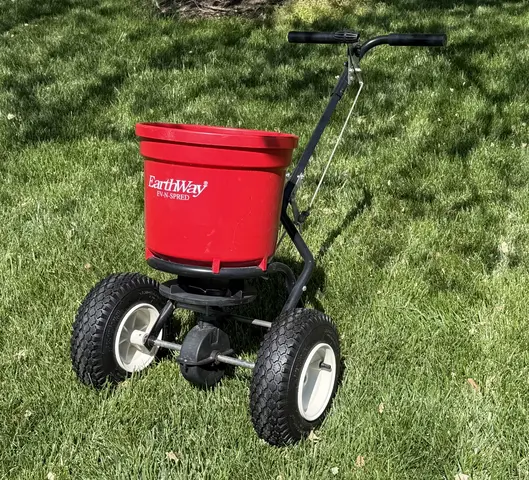
A typical consumer grade spreader holds 40 or 50 lbs of fertilizer. But I only need to apply ~ 8 lbs to my front yard. It is difficult to spread such a small amount with a rotary spreader, because most spreaders don’t evenly spread the last few lbs (due to the height of the impeller above the bottom of the spreader container). The trick is to put additional fertilizer into the spreader that you don’t intend to spread. For instance, instead of putting 8 lbs into my spreader, I put 15 lbs – but only spread approximately half. This helps the fertilizer to spread much easier.
Another way to work around this problem is to use a fertilizer that has a higher ratio of filler, such as Milorganite which is an organic 6-4-0 fertilizer. You’ll need to spread a lot of it, but it will be very easy to spread. Milorganite is a great beginner fertilizer because it is very easy to spread, and it is difficult to overapply.
Watering In Fertilizer
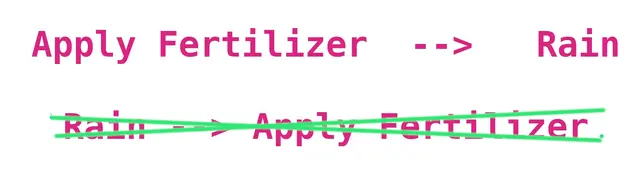
Most fertilizer needs to be watered in within a day or two of application. I normally try to apply fertilizer before a rainy day (check the weather forecast!). You can also use a sprinkler to water-in your fertilizer.
If you skip the watering-in, your fertilizer will not work as well.
NOTE: Do not apply a high nitrogen fertilizer (such as 24-0-6) to wet grass. The reason is because the fertilizer particles will stick to the wet grass and can burn them due to the nitrogen. If this happens, your grass will have dead spots on it (which should grow out and be cut over time).
Conclusion
I hope that the above helps you understand how to measure and apply fertilizer to your lawn. Applying fertilizer will definitely make your grass greener and more energetic.
Feel free to ask any questions in the comments below!
-
You can measure the size of your yard using a tape measure. Alternately, you can use Google Maps “Measure Distance” feature. View your yard on Google Maps, then right-click a corner of the yard. Select “Measure Distance” from the popup menu. Then continue outlining your yard. Once you finish outlining your yard by clicking on the original point, Google Maps will display the area of your yard. Note that these instructions work on a computer as of April 2026. ↩︎